

Getting the right generator size is critical to ensure your home or business stays powered during outages without overspending. A generator that’s too small can fail to run essential appliances, while one that’s too large increases upfront and fuel costs. Here’s how you can calculate your generator load requirements step by step:
- List All Devices: Identify what you’ll power during an outage (e.g., air conditioners, refrigerators, lights).
- Determine Wattage Needs: Find the running and starting wattage for each device. Starting wattage is often much higher for motor-driven appliances.
- Calculate Total Load: Add running wattages and account for the highest starting surge.
- Add a Reserve Margin: Multiply your total by 1.25 to include a safety buffer for unexpected surges or future needs.
- Factor in Power Efficiency: Consider power factors, especially for motor-driven equipment, to ensure proper generator sizing.
In Southwest Florida, where storms often cause extended outages, these calculations are crucial. Professional assessments and tools like clamp-on ammeters can provide accurate measurements, ensuring your generator handles your needs reliably. For tailored solutions, local experts like APS Naples offer services to guide you through the entire process.
How to Size a Standby Electric Generator
Identifying Important and Non-Important Loads
When it comes to choosing the right generator, knowing which devices need power during an outage is key. This step ensures you select the right generator without unnecessary expenses. Clearly identifying your essential and non-essential loads sets the stage for accurate sizing.
What Are Important Loads?
Important loads are the electrical systems you can’t do without, especially during a power outage. In Southwest Florida, where heat and humidity are intense, these systems are crucial for safety and comfort. Examples include:
- Refrigerators: Typically use between 750 and 1,200 watts.
- Central air conditioners: Require 3,500 watts or more.
- Lighting circuits: Around 500 watts.
- Well pumps, sump pumps, and medical equipment: Essential for health and safety.
- Communications devices: Wi-Fi routers and security systems.
For businesses, critical equipment includes point-of-sale systems (about 500 watts), data servers, and security systems – anything necessary for basic operations.
What Are Non-Important Loads?
Non-important loads are the devices you can do without during an outage. While they add convenience to daily life, leaving them out can save you significant generator capacity and cost. These might include:
- Pool pumps: Use 1,500 watts or more.
- Hot tubs and entertainment systems: Entertainment systems typically consume around 300 watts combined.
- EV chargers, wine coolers, and extra refrigerators: Common but non-essential.
- Decorative lighting: Adds aesthetic value but isn’t necessary during an emergency.
In a business setting, this category might include coffee makers (1,000 watts), decorative lighting (200 watts), and non-critical office equipment.
Why Separating Loads Matters
By separating what’s essential from what isn’t, you can reduce the generator’s required capacity, improve efficiency, and save money. For instance, excluding non-essential loads can cut your estimated capacity by up to 25%. In a typical Southwest Florida home, this could mean reducing the load from 20 kW to 15 kW by skipping pool pumps and entertainment systems.
Generators perform better when they operate closer to their optimal load range. Plus, the National Electrical Code mandates that emergency systems should be sized specifically for their intended loads, not oversized for convenience.
To get this right, consider working with professionals like APS Naples. They can analyze your loads and ensure your generator is tailored to your essential needs. With a clear distinction between important and non-important loads, you’ll be ready to calculate the generator size that’s perfect for your situation.
Step-by-Step Guide to Calculating Load Requirements
Once you’ve separated your essential and non-essential loads, it’s time to figure out exactly how much power your generator needs. Following a clear process helps you avoid spending too much or ending up with a system that can’t handle your needs.
Listing All Electrical Devices
Start by listing every device you’ll need during a power outage. Go room by room, and don’t overlook spaces like basements, garages, or outdoor areas where you might have well pumps or security systems.
For example, a typical home in Southwest Florida might include devices like a central air conditioner, refrigerator, freezer, lighting circuits, garage door opener, security system, and Wi-Fi router. To get accurate data, consider using a clamp-on ammeter to measure real-time power usage during peak demand instead of relying solely on nameplate ratings.
If you’re unsure, professionals like APS Naples can perform a load assessment to ensure nothing is missed and provide precise measurements of your power consumption.
Once you’ve compiled your list, the next step is determining the running and starting wattage for each device.
Calculating Running and Starting Wattages
Every electrical device has two key power requirements: running wattage (the power needed to operate continuously) and starting wattage (the surge power needed to start motors).
You can usually find these values on the device’s nameplate, in the user manual, or through manufacturer specifications. If only voltage and amperage are listed, use this formula to calculate wattage: watts = volts × amperes.
Motor-driven devices, like refrigerators and air conditioners, often need a much higher starting wattage – sometimes up to six times their running wattage. For example:
- A refrigerator might use 700W while running but require 2,200W to start.
- A central air conditioner might run at 2,000W but need 6,000W to start.
These surges are critical to account for, especially if multiple motor-driven devices might start simultaneously.
Summing Total Wattage
Add up the running wattages for all your devices. Then, identify the device with the highest starting wattage and add only the extra surge it requires (the difference between its starting and running wattage) to your total running load. You don’t need to add every device’s starting wattage because they won’t all start at once.
For example:
- Refrigerator: 700W running
- Central AC: 2,000W running, 6,000W starting
- Lights: 800W
- Sump Pump: 600W
Total running wattage is 4,100W. Adding the AC’s additional surge (6,000W – 2,000W = 4,000W) brings the total to 8,100W.
Converting to Kilowatts (kW)
To align with generator ratings, convert your total wattage to kilowatts by dividing by 1,000. Using the example above:
8,100W ÷ 1,000 = 8.1kW
To ensure your generator can handle unexpected loads or additional surges, include a reserve margin. Multiply your total by 1.25:
8.1kW × 1.25 = 10.1kW
| Step | Formula | Result |
|---|---|---|
| Total Running Watts | Sum all device running watts | 700W + 2,000W + 800W + 600W = 4,100W |
| Add Largest Surge | Running watts + (largest starting wattage – running wattage) | 4,100W + (6,000W – 2,000W) = 8,100W |
| Convert to kW | Total watts ÷ 1,000 | 8,100W ÷ 1,000 = 8.1kW |
| Add Reserve Capacity | kW × 1.25 | 8.1kW × 1.25 = 10.1kW |
Considering Power Factor
Finally, consider the power factor to ensure your generator can handle the actual load. Power factor is especially important for motor-driven devices. Here’s a quick breakdown:
- Motor-driven loads often have a power factor of 0.80.
- Mixed loads typically range between 0.85 and 0.95.
- Purely resistive loads, like lighting or heating, have a power factor of 1.0.
Getting the power factor right ensures your generator runs reliably and avoids costly mistakes when it’s needed most.
Adding Reserve Margin and Considering Power Factor
Once you’ve calculated your total load, the next step is fine-tuning your generator sizing by factoring in reserve margin and power factor. These two considerations are essential for ensuring your generator performs reliably under real-world conditions, not just on paper. Let’s break them down.
Including a Reserve Margin
A reserve margin is essentially a safety buffer – extra capacity added to your calculated load. Experts generally recommend adding 20–25% to your total load. Why? Because life happens. Electrical demands can shift over time, whether it’s due to new appliances, HVAC upgrades, or other additions.
For instance, if your total load is 10,000 watts, applying a 25% reserve margin means you should look for a generator rated at 12,500 watts. This extra capacity ensures your generator can handle unexpected load increases, voltage fluctuations, and the simultaneous startup of multiple devices during outages. It’s particularly important for motor-driven equipment, which often demands a surge of power to start. Even if you’ve already accounted for the largest surge, this margin provides peace of mind for extended outages when systems cycle on and off.
In short, the reserve margin acts as a buffer for unpredictable conditions, like those that often occur during storms.
Understanding Power Factor
Power factor might sound technical, but understanding it can save you from choosing the wrong generator. It reflects how efficiently electricity is used, with typical values ranging from 0.8 to 1.0.
Here’s the deal: not all equipment uses power the same way. Resistive loads, like electric heaters and incandescent lights, have a power factor of 1.0. They use electricity efficiently, requiring no adjustments. But motor-driven or inductive loads – think air conditioners, refrigerators, or well pumps – often have power factors as low as 0.8. These loads need more apparent power (measured in kVA) than the real power they consume (measured in kW).
To size your generator properly, divide the total real power (kW) by the power factor to find the necessary kVA rating. For example, if your load is 10 kW and the power factor is 0.8, you’ll need a generator rated for at least 12.5 kVA (10 kW ÷ 0.8 = 12.5 kVA).
Here’s a quick look at how power factor impacts generator sizing:
| Load Type | Typical Power Factor | Impact on Generator Sizing |
|---|---|---|
| Resistive (lighting, heating) | 1.0 | Minimal adjustment needed |
| Mixed residential loads | 0.85–0.95 | Moderate adjustment required |
| Motor-driven equipment | 0.8 | Significant adjustment required |
If power factor isn’t considered, a generator that seems adequate on paper might fail to start critical devices like an air conditioner or well pump. This is especially crucial for homes in Florida, where large HVAC systems often dominate the electrical load.
When you work with APS Naples for your generator installation, their team conducts professional site surveys that account for both reserve margin and power factor. This ensures your generator is correctly sized for your specific equipment and local conditions, helping you avoid costly mistakes and guaranteeing reliable power when the next storm rolls through Southwest Florida.
sbb-itb-f7f5bf2
Using Tools and Local Expertise
Once you’ve worked through the load calculation steps, tools and local expertise can take your generator sizing to the next level. While calculating generator loads can feel overwhelming, the right tools make the process much more manageable.
Using Generator Sizing Calculators
Online generator sizing calculators are a convenient way to estimate the size of the generator you need. By entering details like total wattage or amperage, power phase, voltage, and power factor, these tools can provide an estimated size in kilowatts (kW) or kilovolt-amperes (kVA) to match your load requirements.
Some calculators, such as those offered by Kopperfield and Lowe’s, go a step further. They allow you to input individual household appliances and devices, automatically summing their wattages and converting the total to amperage, simplifying the generator selection process. For professionals, tools like GenSizer™ are especially useful. This software generates detailed load calculations that meet the requirements for permit applications and client presentations, adhering to the National Electric Code (NEC) Article 702.5.
While these calculators are helpful, they aren’t perfect. Factors like simultaneous equipment usage, specific installation needs, and local environmental conditions may not be fully considered. To ensure accuracy, pair these estimates with real-world measurements.
The Value of Real-Time Measurement
Real-time measurement tools provide actual data on your electrical usage, offering a more precise picture than theoretical estimates. Clamp-on ammeters, for instance, are excellent for measuring current directly from your service panel.
Using a clamp-on ammeter is straightforward. For single-phase systems, clamp the device around one conductor. In three-phase systems, measure each phase individually and sum the readings. To calculate the power in kilowatts, multiply the total amperage by the supply voltage and then divide by 1,000.
By combining online estimates with real-time and historical data, you can achieve a more accurate load calculation. This approach helps account for fluctuations in usage, ensures the generator can handle peak loads, and reduces the risk of oversizing or undersizing.
Getting Professional Assistance from APS Naples
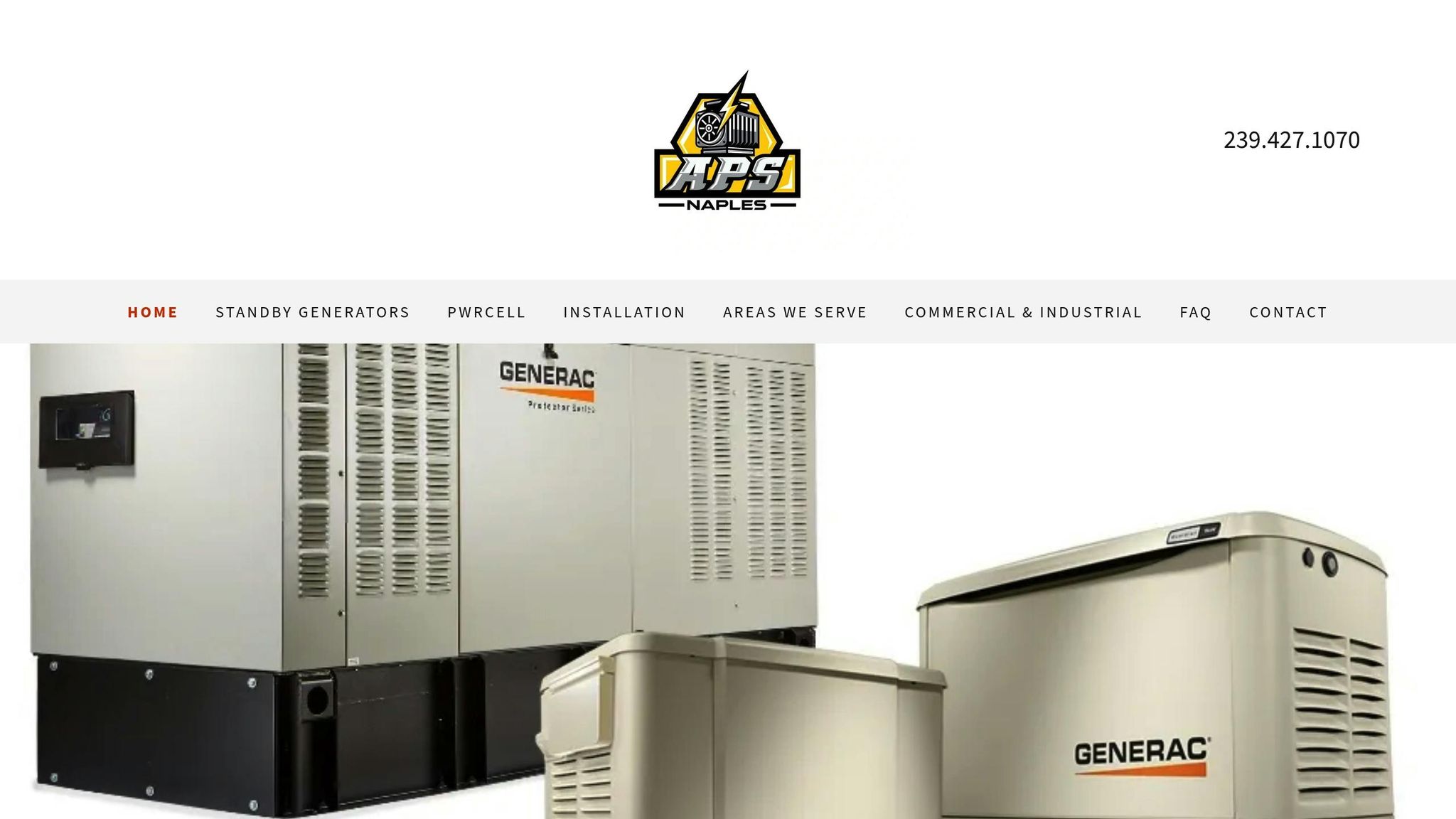
Online tools and measurements are useful, but when it comes to ensuring your generator is sized perfectly for your specific needs, professional expertise is invaluable – especially in Southwest Florida. APS Naples offers tailored generator sizing services, including site surveys, installation, permitting, fuel setup, and maintenance for Generac standby generators, EV chargers, and PWRcell battery storage systems.
Their process includes precise on-site evaluations of electrical loads, site conditions, and local requirements. These surveys often involve real-time electrical measurements, reviewing appliance and equipment lists, assessing environmental factors, and separating essential from non-essential loads. This ensures your generator is sized to handle exactly what you need.
"Our licensed crew sizes it just right, sets the pad, hooks up fuel, and tests it to shine when the grid flops."
APS Naples also brings a deep understanding of the unique challenges in Southwest Florida, from high humidity and salt air to hurricane readiness. They handle everything – from securing permits and HOA approvals to ensuring proper pad placement, fuel hook-up, system testing, and inspections – making the entire process seamless.
Beyond installation, APS Naples provides start-up services, homeowner training, and ongoing support through custom maintenance plans and warranty assistance. This ensures your generator stays ready to handle the demands of Southwest Florida’s ever-changing environment.
Selecting the Right Generator for Your Needs
Once you’ve determined your load requirements, the next step is finding a generator that matches those needs. This means diving into manufacturer specifications, comparing critical features, and taking into account the specific challenges posed by Southwest Florida’s climate and weather. It’s also essential to review performance charts to ensure the generator can handle both continuous and surge power demands.
Reviewing Manufacturer Performance Charts
Manufacturer performance charts are a crucial resource when evaluating generators. These charts outline details like rated output, maximum surge capacity, voltage, frequency, power factor, and adjustments for temperature or altitude. The goal is to ensure the generator’s continuous rating meets or exceeds your total running load, while its starting capacity can handle the highest inrush current from motors or other equipment.
For instance, if your load calculation indicates a running requirement of 30 kW and a starting surge of 45 kW, you’ll need a generator with a minimum of 30 kW continuous output and 45 kW surge capacity. It’s especially important to distinguish between running (continuous) capacity and starting (surge) capacity. The running capacity is the maximum load the generator can sustain over time, while the starting capacity covers brief spikes in power demand – like when large motors start up, which can require 3–7 times their running wattage.
Take a 5-ton air conditioner as an example: it may need 6,000 watts to run but could demand 18,000 watts at startup. If your generator’s surge rating doesn’t meet this peak requirement, the air conditioner won’t start during an outage.
Comparing Key Specifications
When narrowing down your options, it’s helpful to compare key performance metrics side by side. Consider factors like rated output, surge capacity, fuel type, runtime, noise level, maintenance intervals, automatic transfer switch compatibility, and warranty terms. Here’s a quick example:
| Model | Rated kW | Surge kW | Fuel Type | Runtime (hrs) | Noise (dB) | Maintenance Interval | Warranty |
|---|---|---|---|---|---|---|---|
| Generac 22kW | 22 | 24 | NG/LP | 10 | 67 | 200 hrs/2 yrs | 5 yrs |
| Kohler 20kW | 20 | 22 | NG/LP | 9 | 69 | 150 hrs/1 yr | 5 yrs |
This kind of table makes it easier to weigh the pros and cons of each model, helping you find the best combination of capacity, efficiency, and maintenance for your needs.
Factoring in Local Considerations
Once you’ve compared the technical specs, it’s time to think about how the generator will perform under local conditions. Southwest Florida’s environment poses unique challenges that should guide your decision. For instance:
- Hurricane preparedness: Generators with weatherproofing and extended runtime capabilities are essential for multi-day outages.
- Humidity and salt air: Look for models with corrosion-resistant enclosures to prevent wear and tear.
- Fuel availability: During hurricanes, natural gas supplies can be disrupted. Propane or diesel with on-site storage may offer a more reliable option. You’ll also want to size your fuel storage based on how many days of backup power you anticipate needing.
For a typical home with central air conditioning, a refrigerator, a well pump, and essential lighting, a load of about 12 kW running and 20 kW surge is common. Adding a buffer, a generator with 15 kW continuous and 20 kW surge capacity is a solid choice. A Generac 20 kW standby generator, for example, would meet these requirements while offering automatic transfer and dependable performance during hurricane season.
Don’t forget about local regulations and permits. In Collier County, your generator must comply with specific codes and HOA requirements, which can vary by neighborhood. Professional installation services, such as APS Naples, handle this process for you, ensuring everything from site surveys to permitting and fuel setup is done correctly.
Lastly, keep in mind the costs involved. Home standby generators (10-22 kW) typically range from $3,000 to $6,000 for the unit itself, with installation adding another $2,000 to $5,000. For larger commercial units (30-60 kW), equipment costs can range from $8,000 to $20,000 or more, with installation costs varying based on site and fuel requirements.
Conclusion: Ensuring Reliable Power with Proper Generator Sizing
Accurate load calculations form the backbone of ensuring reliable backup power. In Southwest Florida, where hurricanes and severe weather can knock out electricity for days, having a generator that’s sized correctly can make all the difference. It ensures your home or business stays powered through the storm, tying together the detailed calculations and regional factors discussed earlier.
Key Takeaways
Calculating generator load requirements is a straightforward process that ensures your backup power system works when you need it most. The first step is identifying which devices are essential and which are not. Essentials often include air conditioning units, refrigerators, and well pumps, while items like hot tubs or workshop tools may fall into the non-essential category.
Understanding the difference between running wattage and starting wattage is equally important. Motors, for example, can demand significantly more power when starting up than during regular operation. Adding a 25% reserve margin to your calculations gives you some breathing room, helping your system run efficiently and reliably under varying conditions.
Using multiple methods to calculate your power needs – such as monitoring peak usage, reviewing utility bills, or referencing equipment specifications – can increase confidence in your final numbers. Cross-checking these approaches ensures accuracy and minimizes the risk of underestimating your requirements.
Technical factors also play a role. For example, a lower power factor means your generator will need to be larger to deliver the same amount of usable power. If your setup requires three-phase power, that adds another layer of complexity. Professional tools and expertise are invaluable here, ensuring your system meets local electrical codes and functions as intended.
In Southwest Florida, specific challenges like extended outages during hurricane season, high humidity, salt air corrosion, and heavy air conditioning demands must be factored into the equation. A generator that works well in another region might not be suited for these conditions.
Next Steps
To move forward, start by gathering a list of the devices you want to power during an outage. Note both the running and starting wattages for each item. While online calculators can provide a rough estimate, they often fall short when it comes to accounting for real-world usage patterns, local environmental conditions, and specific equipment needs. Hands-on measurements and professional assessments are crucial to getting it right.
For personalized assistance, reach out to APS Naples. Their team offers comprehensive services, including site surveys, precise load calculations, permitting, fuel setup, and ongoing maintenance. As one satisfied customer, Matthews Dasilva, shared in his review:
"The team was professional, on time, and knew their stuff when it came to Generac. They answered all my questions, kept me updated, and made the whole process easy. It’s a good feeling knowing I can count on them. I’m very glad I chose APS and definitely recommend them."
Proper generator sizing doesn’t just ensure reliability – it also brings peace of mind. When the next hurricane hits Southwest Florida, you’ll be ready with a backup power system that’s designed to meet your needs from the start.
APS Naples specializes in Generac standby generators, EV chargers, and PWRcell battery storage systems. From initial assessments to long-term maintenance, they provide a complete solution to keep your home or business powered when the grid goes down.
FAQs
How can I calculate the difference between running wattage and starting wattage for my appliances?
To figure out the difference between running wattage and starting wattage for your appliances, take a look at the labels or user manuals for each device. Running wattage is the amount of power an appliance needs to operate continuously. On the other hand, starting wattage – sometimes called surge wattage – is the extra power required to get the appliance up and running, particularly for devices with motors like refrigerators or air conditioners.
Typically, starting wattage is 1.5 to 3 times higher than running wattage. To estimate the total load your generator needs to support, add up the running wattage of all your essential appliances, then factor in their starting wattage. If you’re unsure or need precise guidance, APS Naples offers personalized generator sizing and installation to match your specific power requirements.
Why should I include a reserve margin when calculating generator load requirements?
When calculating generator load requirements, it’s crucial to include a reserve margin. This extra capacity ensures your generator can handle unexpected power demands, like sudden appliance surges or unplanned electrical needs during an outage.
Skipping this step could leave your generator vulnerable to overloads, which might cause failures or reduced efficiency. By accounting for a reserve margin, you help guarantee that your generator runs reliably and delivers steady power, even during peak usage.
Why is the power factor important when choosing the right generator size?
The power factor plays a key role when choosing a generator, as it indicates how effectively electrical power is being utilized. Represented as a value between 0 and 1, most residential and commercial setups typically operate with a power factor of 0.8. A lower power factor means your equipment will draw more current to perform the same tasks, which directly impacts the generator’s capacity.
To properly size your generator, you need to factor in the power factor. This ensures the generator can manage both the active power (used for actual work) and reactive power (non-working energy) required by your appliances and equipment. By doing so, you maintain smooth performance and reduce the risk of overloading during use.